Stopping to Ask Directions

At the Alterian ‘Engaging Times’ conference in Chicago in August, I was struck by the number of people who were just so keen to get going with all this social stuff. They just wanted to dive straight in – it all sounded and looked so uber cool!

People were from all kinds of inductry sectors – from estate agents to car dealerships so restaurant chains, B2C and B2B.

Well diving straight in can be great of course. But there are dangers down there. Having reflected on my experience a the conference now, I guess what the people who were listening to the great and the good in social media back then were saying was “I wish we’d been on this stuff earlier”. Just like the lost tourist who asks a local for directions, only to hear “Well I wouldn’t start from here”!

And yet there’s no choice. Here we are. The here and now with the world of Twitter and Facebook changing more and more, emails from Mashable and Techcrunch backing up further and further, it’s a wonder we don’t all feel swamped.

So I think it’s good to just take a minute or two to remind ourselves that no matter what technological changes happen between you starting to read this post and the end, we should all still be focussed on the same thing – the customer and prospective customer, who are just human beings requiring engagement on a human level.

Don’t get overawed by the tools (they are just that) or the speed of change. The winners on the social web will always be the ones who continue to engage on a human level and not get bogged down in their latest app or funky new ‘thing’.

It’s never too late to show a human face to the customer.

What do you think?

HP Slate 500 launches to take on iPad and Playbook

After delays and rumours of the project being canceled, HP have announced the launch of their Slate 500 tablet mobile device to rival bot Apple’s iPad and the Blackberry playbook.

Heralded as a being able to perform exactly as a Windows based PC, the Slate 500 will be available in no less than 8 versions.

Here are the specs, according to HP and Energy Star’s websites:

– Runs Windows 7 Premium
– 8.9″ screen
– Two cameras: video camera for web conferencing and a still camera
– Works with a stylus/pen interface
– 1 GB of RAM (for reference, the iPad has 256 MB)

It will also have a USB port which the iPad is currently lacking.

Aimed at the business user, the Slate 500 will retail at $799.

This surely reinforces the view that the tablet will be the dominant platform for accessing the internet in the future, but who will win out in the end?

iPad Sales Fall Short of Target

Quarterly results published by Apple yesterday revealed that 4.2m iPads had been sold, down against analysts predictions of 5m.

This is against a backdrop of encouraging sales data for the iPhone – 14.1m (up 91.4% on the same quarter last year) and iMac computers – 3.9m (up 27% against the same period).

I would suggest that supply problems – I certainly noticed my local Best Buy were out of stock recently, combined with consumers awaiting the launch of iPad 2.0 are significant factors behind these reports.

However, as reported here, the iPad is shortly to be available in Wal-Mart and is already being stocked by Target as Apple makes attempts to widen distribution.

I stick to my prediction that the iPad will become the dominant platform for accessing the internet in 3-5 years.

Am I wide of the mark?

Google Instant – Warning Contains Adult Content and a Disappointing Level of Service.

Last month I published a small post about the launch of Google instant and the possible effects it might have for paid search. But yesterday I read an amazing article by Danny Sullivan of Search Engineland about some bizarre results that Google presents to people on via it’s Images search function.

If you are of a delicate disposition or easily offended, PLEASE stop reading now!

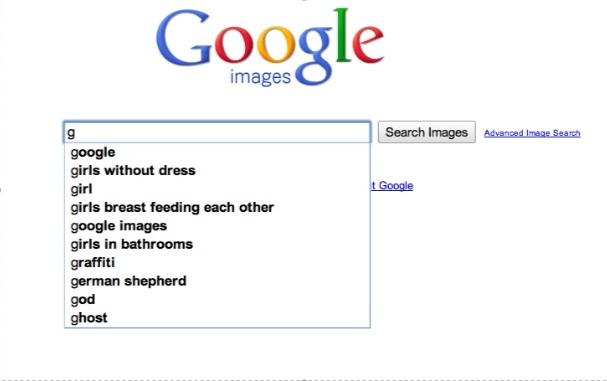
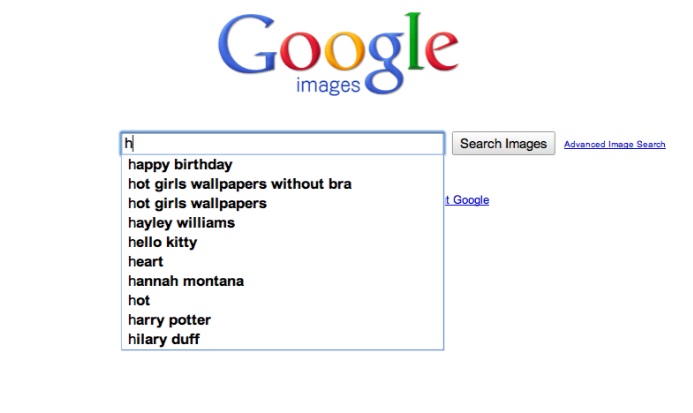
I’ve added my screen grabs so that you can see he didn’t make this up. But try it yourself!

If you type ‘G’ into Google Images the top suggested search results are:

google

girls without dress

girl

girls breast feeding each other

And another step through the alphabet to ‘H’ produces these results:

So images of girls, girls without dresses and hot girls top the lists for Google Image search.

Of course, we shouldn’t really be surprised by this. And Danny Sullivan gives some expert insight into how users can change their settings to protect themselves and others from these results. That’s not the purpose of this post.

The point of this article, (apart from being astonished at these results) is that it serves as a warning to businesses generally against over automating its processes.

OK, so this is an extreme example, I’m not suggesting Google employ millions of people to tailor search results for its users; its algorithms stand by each of us every day with no complaints whatsoever. But for those of you who have an FAQ’s section on your website, or a CRM system with 4 options – none of which answer my question – beware! What people really crave when interacting with a company or organisation is a human reaction and the bar has been raised!

Fall beneath this bar at your peril.


Is Social Media a Coward’s Charter?

As one commentator on his blog has just reminded me, “Social media allows us to express (opinions) quickly, easily and without responsibility.”

Freedom of speech has never felt quite so at home as on social media. We can say what we like, when we like and to whomever we like. This sense of freedom manifests itself on any number of comments made by sports fans on their favourite teams Facebook page after a poor performance. The vitriol can be quite jaw dropping on occasion!

But as history teaches us, freedom without responsibility is no freedom at all.

Now this is a deeply philosophical point and not one I’m going to attempt to start a broader debate on now. But in the scope of this blog and its interest in the development of social tools and peoples use of them, are the examples of people power,  we see everyday ranging from positive (fund raising) to highly damaging (cyber bullying) as far as we are going to get?

How will our use of these tools play out in the decades to follow?

These are early days in the history of social media and people are still finding their feet. In addition, no sooner have we done so, than Facebook or someone else has invented a new app to move the goalposts yet again causing another behavioral change.

Will social media mean that we develop and build a new social contract with each other where greater respect, tolerance and understanding – even of those who decide to change their logo! – is achieved?

Does ‘Like’ Go Far Enough? – Rosa Parks’s Facebook Status

Someone I spoke to the other day made a the comment – “What would the Victorians or Tudors have made of social media?”

Got me thinking. And then I read this article by Malcolm Gladwell in the New Yorker – an eloquent condemnation of the notion that it’s social media tools that have empowered people to make real change. He sure has a point.

Martin Luther King didn’t need Twitter to mobilise a movement. He didn’t say “I have a mission statement”, and Rosa Parks didn’t post on Facebook “Rode the bus today – some people got a bit angry when I wouldn’t give up my seat. Let’s start a revolution. Please ‘Like’ this”.

In fact when you consider relatively recent historical events of say the last 200 years, it’s quite humbling to see what has been achieved, all without social networks.

Think, William Cobbet’s pamphlets opposing the Corn Laws and support for Catholic Emancipation. Think, the Great Reform Acts, the Suffragettes, the Chartists, the Levellers, the overthrow of Ceaucescu and the Poll Tax riots. All examples of people power and mass mobilisation. The power of word of mouth and engagement. “Come down to Kennington Common – bring a friend” probably wasn’t exactly how the Chartists organised themselves, but you get the idea.

And so are we any more different or more powerful than these people in history, now that we have Facebook and Twitter?

Well, as I wrote about this week, a movement of people have persuaded Gap to change their logo inside a week of launching a new one,  by mobilising quickly and effectively on social media and scaring the bejeezus out of a major brand.

But now doesn’t that sound lame?

The best we can do through these channels is to persuade a business to change its logo because we don’t like it. I’m not disparaging this event. In the history of business and commerce I think it’s a massive one. One that will be written about for years.

But where are the flashmobs organised on Twitter and Facebook to protest against the travesty that is  young carers having their childhoods taken from them as they have to perform the tasks that their handicapped parents are unable to carry out for example?

Have we lost sight of what really matters and of what social tools could really do to help raise awareness and mobilise action? Has the nature of these tools themselves actually isolated and numbed people from what’s really happening in the world?

What if people had clicked ‘Like’ on Rosa Parks’s Facebook status? Would they have left it at that and gone back to their lives?

I’m not sure. What do you think?


Facebook Jumps Into Bed With Microsoft

This week Mark Zuckerberg announced that Facebook would be joining forces with Bing, by adding a ‘Bing Social’ search facility providing links to topics being discussed on Facebook.

This new collaboration with Microsoft puts Facebook in further competition with online search giant Google Inc. But Zuckerberg called Microsoft,  the “underdog” in search.

“I couldn’t think of anyone better to work with on the next generation of search,” Zuckerberg said.

So recommendations for restaurants or movies will now appear as a result of Facebook discussions and ‘social search’ will be a powerful element in making word of mouth truly the greatest channel that marketers will need to address.

But the adage “You are what Google (or Bing in this case) says you are” will be never more true!

So be careful when updating your status. If you wouldn’t say it to your Granny, then it’s probably best not to say it – it will be there forever!

For as the even truer adage goes, “You can’t take pi$$ out of a swimming pool!”

The North Face Tests Geo-Fencing

Fashion brand, The North Face, are to test geo-fencing in an attempt to promote offers and tailored information to opted in customers.

31 of the their stores have been selected for the test which will identify people who have previously opted in to receive these messages via SMS, once they enter a 1.5 mile radius of a selected location. People will effectively check and check out when they enter or leave a location.

As customers will have been profiled by the brand previously, the potential to promote relevant offers directly to people near a store is a tempting thought. Of course opting out is easy – a customer simply has to text ‘STOP’ and they’ll stop receiving these messages.

This seems like a great example of a brand grabbing the bull by the horns and capitalising on the increased usage of Facebook’s Places and Four Square by becoming an early adopter of the technology.

I can imagine a shopping trip in the not too distant future, simply being a case of turning up at the mall, grabbing a coffee at at the shop offering you the best deal on coffee that day and then just waiting for the offers to roll in.

Verizon – Are You Listening?

I’m not letting up on this issue.

For me examples like this are the very reason this blog exists.

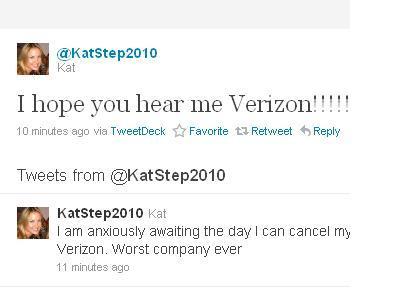
Here’s someone, clearly having trouble with Verizon. There’s no judgement here as to whether their complaints are justified or not. But that doesn’t matter. @KatStep2010 clearly does have issues.

So, as she says, are Verizon listening? If so, will they engage?

I’m going to be following this closely and will report back if anything happens in public.

Since starting this, here’s an update already!

KatStep2010
I can’t get thru to anyone they keep sending me bills for an account I canceled in June. @Verizon is there anybody out there?
14 minutes ago
KatStep2010
@Verizon Why have I been on hold for 45 minutes? and why oh why won’t you help me?
30 minutes ago
So it seems Verizon aren’t listening.
Another great truth:

“Customers wouldn’t feel the need to embarrass us en masse, if our customer service channels weren’t so completely broken.” Bob Knorpp, The Beancast

Gap’s About Turn – Strength or Weakness?

Yesterday was a big day for the retailer Gap.

Having announced that they were to change their logo just a week ago, they have now reverted back to their traditional blue box.

And the reason for this change of heart is the huge outcry and anger amongst Gap’s customers that they have expressed through social media.

Here are a couple of quotes from Gap:

“Ok. We’ve heard loud and clear that you don’t like the new logo. We’ve learned a lot from the feedback. We only want what’s best for the brand and our customers. So instead of crowd sourcing, we’re bringing back the Blue Box tonight.”

“We’ve learned a lot in this process. And we are clear that we did not go about this in the right way. We recognize that we missed the opportunity to engage with the online community.”

As someone who has been involved in a rebranding process for two major high street brands, I know that a logo change is an 18 month process – minimum. For Gap, this must have included customer focus groups, test marketing and a whole host of other research activities before, firstly they decided to launch a new logo at all and secondly undertake all the work necessary to ensure a transition on the ground from old to new.

So for this process to have been turned into  a costly waste of time and money inside one week, is astonishing.

I can’t think of another example of ‘people power’ that comes close to this. The Gap logo episdoe will surely become case study worthy for all students of marketing in the future.

And yet the fantastic news for Gap in all of this is that they now know, beyond any doubt, that they have a rich vein of customers who love the brand deeply. Care about it passionatley enough to feel moved to mobilise so quickly and express their feelings. This episode proves Kevin Roberts’ great truth “Lovemarks are owned by the people who love them”.

Of course Facebook and Twitter were the main vehicles for this movement. But the speed at which people were able to organise and mobilise is jaw dropping.

There are now sites selling T-shirts with the words “Logo Fail’ across the chest. This story has become huge.

And if anyone doubted that they can afford to stand by and continue to believe that they don’t have to engage directly with customers, then here is the lesson  – Engage or Die.

Of course Gap could have stuck to their guns. They could have done so in a engaging way – “We hear you, but trust us.”

They chose not to.

Do you think they did the right thing?