The Monarchy Gets Sociable

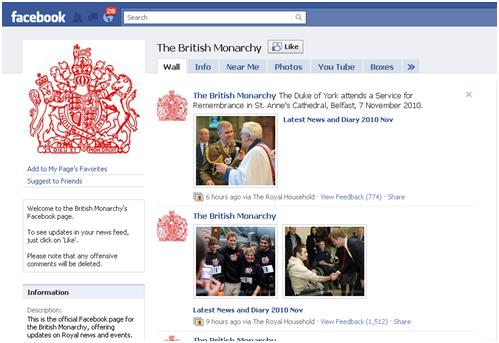
No doubt many of you have already picked up the fact that H.M. The Queen has launched a fansite on Facebook.

This is tremendous stuff and I will avoid trying to make a witty quip on the subject, but have this post simply serve to record this great event!

The iPod toting Monarch now lives on Facebook and I for one see this as adding certain validity to FB – I think that’s just me.

Already on Twitter, You Tube (The wonderfully named “The Royal Channel”) and Flickr, the Queen is now showing how irresistible social tools are in messaging her subjects.

Perhaps this also highlights the older demographic that social tools are now attracting?

Facebook Launches ‘Deals’

As social commerce has grown over the last few months through sites like Groupon and location based apps like Four Square and Gowalla, Facebook today dropped their bomb in the middle of all of this.

Facebook Deals launched today in beta and is only available in the US to those businesses who have claimed their ‘places’.

‘Deals’ offers local businesses the chance to launch four types of deal – one off, group, loyalty and charity and the opportunities it affords local businesses are growing customer loyalty, growing through WOM (word of mouth) and recruiting new customers.

Let’s look at each.

Growing Loyalty – A local retailer can create a deal whereby a discount can be claimed if a customer checks in between 2 and 20 times.

Growing through WOM – If the average facebook user has 130 friends, the hope is that a deal will viral through you fans network very quickly.

Acquiring new customers – with 200 million people using Facebook through their mobile device, an opportunity now exists to attract nearby potential customers to your store.

This all sounds great and the sheer size of Facebook means the potential is staggering for local businesses.

But just a few months after Twitter dropped their offers function, I guess Facebook are treading lightly.

A gamechanger? What do you think?

The Opposite Of Love

Ask yourself that question – just what is the opposite of love?

Clearly all the cliches will dictate the answer is ‘hate’ – and that it’s a thin line! However, this post will seek to point out that, in the context of business and customer relationships, the opposite of love is indifference.

If a customer complains to you directly, you’ve already probably talked to your customer care team, to treat this as an opportunity to over deliver in making things right and delighting them with the resolution.

Of course this is absolutely right. But what if a customer becomes disillusioned with you, but doesn’t take the step of complaining?

Well I would suggest that this is worst scenario of all. If you’re measuring your customer loyalty rates and need to grow your level of retention (and who doesn’t?), then other than reach out to them with emails, catalogues or advertising, how can you address this silent majority of people who don’t communicate with you directly anymore?

First of all, consider the results from the Alterian (Your Brand at Risk? Or Ready for Growth? 2010) suggests the following

  • 84% of people trust recommendations from their friends
  • 70% of people trust recommendations from complete strangers!
  • But just 5% of people trust advertising

So if you’re tempted to increase your promotional spend to reach out to this group and consider that if just 5% of people will believe what you say, but  70% of people trust what a complete stranger says, then the power of word of mouth very soon, becomes apparent.

But if they’re not complaining to you directly, how do you find these customers?

Firstly, you have to listen. I’ve written extensively about the various SMM (social media monitoring) tools that are available to dial in to conversations about your brand or your products. But the skill in maximising on the opportunities that these tools offer, lies in learning where the communities of lapsed customers are hanging out.

If you can build positive sentiment amongst your key influencers – SMM tools can help you identify them and their communities – then you are in a really strong position to win back these lapsed customers. It’s almost a case of redefining testimonials.

How are you looking to engage with your lapsed, indifferent customers?

Stopping to Ask Directions

At the Alterian ‘Engaging Times’ conference in Chicago in August, I was struck by the number of people who were just so keen to get going with all this social stuff. They just wanted to dive straight in – it all sounded and looked so uber cool!

People were from all kinds of inductry sectors – from estate agents to car dealerships so restaurant chains, B2C and B2B.

Well diving straight in can be great of course. But there are dangers down there. Having reflected on my experience a the conference now, I guess what the people who were listening to the great and the good in social media back then were saying was “I wish we’d been on this stuff earlier”. Just like the lost tourist who asks a local for directions, only to hear “Well I wouldn’t start from here”!

And yet there’s no choice. Here we are. The here and now with the world of Twitter and Facebook changing more and more, emails from Mashable and Techcrunch backing up further and further, it’s a wonder we don’t all feel swamped.

So I think it’s good to just take a minute or two to remind ourselves that no matter what technological changes happen between you starting to read this post and the end, we should all still be focussed on the same thing – the customer and prospective customer, who are just human beings requiring engagement on a human level.

Don’t get overawed by the tools (they are just that) or the speed of change. The winners on the social web will always be the ones who continue to engage on a human level and not get bogged down in their latest app or funky new ‘thing’.

It’s never too late to show a human face to the customer.

What do you think?

HP Slate 500 launches to take on iPad and Playbook

After delays and rumours of the project being canceled, HP have announced the launch of their Slate 500 tablet mobile device to rival bot Apple’s iPad and the Blackberry playbook.

Heralded as a being able to perform exactly as a Windows based PC, the Slate 500 will be available in no less than 8 versions.

Here are the specs, according to HP and Energy Star’s websites:

– Runs Windows 7 Premium
– 8.9″ screen
– Two cameras: video camera for web conferencing and a still camera
– Works with a stylus/pen interface
– 1 GB of RAM (for reference, the iPad has 256 MB)

It will also have a USB port which the iPad is currently lacking.

Aimed at the business user, the Slate 500 will retail at $799.

This surely reinforces the view that the tablet will be the dominant platform for accessing the internet in the future, but who will win out in the end?

iPad Sales Fall Short of Target

Quarterly results published by Apple yesterday revealed that 4.2m iPads had been sold, down against analysts predictions of 5m.

This is against a backdrop of encouraging sales data for the iPhone – 14.1m (up 91.4% on the same quarter last year) and iMac computers – 3.9m (up 27% against the same period).

I would suggest that supply problems – I certainly noticed my local Best Buy were out of stock recently, combined with consumers awaiting the launch of iPad 2.0 are significant factors behind these reports.

However, as reported here, the iPad is shortly to be available in Wal-Mart and is already being stocked by Target as Apple makes attempts to widen distribution.

I stick to my prediction that the iPad will become the dominant platform for accessing the internet in 3-5 years.

Am I wide of the mark?

Google Instant – Warning Contains Adult Content and a Disappointing Level of Service.

Last month I published a small post about the launch of Google instant and the possible effects it might have for paid search. But yesterday I read an amazing article by Danny Sullivan of Search Engineland about some bizarre results that Google presents to people on via it’s Images search function.

If you are of a delicate disposition or easily offended, PLEASE stop reading now!

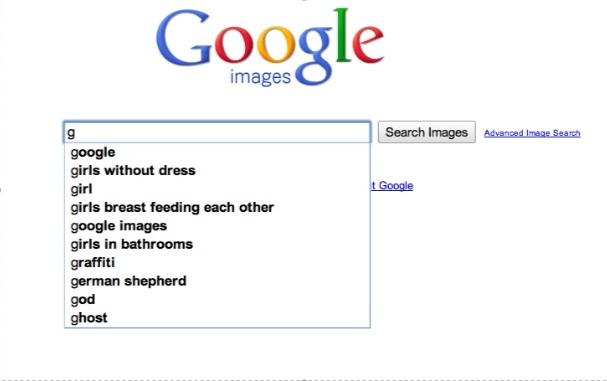
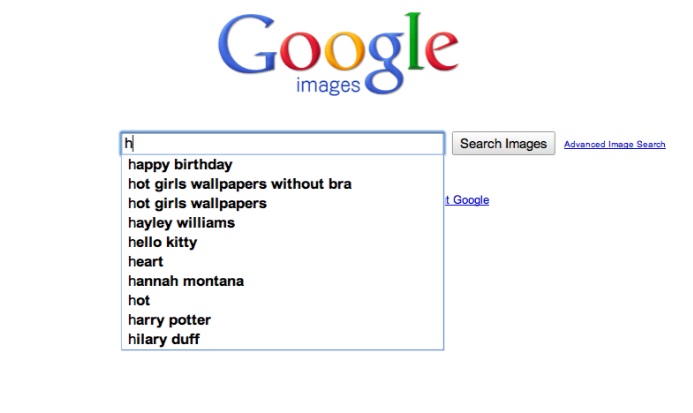
I’ve added my screen grabs so that you can see he didn’t make this up. But try it yourself!

If you type ‘G’ into Google Images the top suggested search results are:

google

girls without dress

girl

girls breast feeding each other

And another step through the alphabet to ‘H’ produces these results:

So images of girls, girls without dresses and hot girls top the lists for Google Image search.

Of course, we shouldn’t really be surprised by this. And Danny Sullivan gives some expert insight into how users can change their settings to protect themselves and others from these results. That’s not the purpose of this post.

The point of this article, (apart from being astonished at these results) is that it serves as a warning to businesses generally against over automating its processes.

OK, so this is an extreme example, I’m not suggesting Google employ millions of people to tailor search results for its users; its algorithms stand by each of us every day with no complaints whatsoever. But for those of you who have an FAQ’s section on your website, or a CRM system with 4 options – none of which answer my question – beware! What people really crave when interacting with a company or organisation is a human reaction and the bar has been raised!

Fall beneath this bar at your peril.


Is Social Media a Coward’s Charter?

As one commentator on his blog has just reminded me, “Social media allows us to express (opinions) quickly, easily and without responsibility.”

Freedom of speech has never felt quite so at home as on social media. We can say what we like, when we like and to whomever we like. This sense of freedom manifests itself on any number of comments made by sports fans on their favourite teams Facebook page after a poor performance. The vitriol can be quite jaw dropping on occasion!

But as history teaches us, freedom without responsibility is no freedom at all.

Now this is a deeply philosophical point and not one I’m going to attempt to start a broader debate on now. But in the scope of this blog and its interest in the development of social tools and peoples use of them, are the examples of people power,  we see everyday ranging from positive (fund raising) to highly damaging (cyber bullying) as far as we are going to get?

How will our use of these tools play out in the decades to follow?

These are early days in the history of social media and people are still finding their feet. In addition, no sooner have we done so, than Facebook or someone else has invented a new app to move the goalposts yet again causing another behavioral change.

Will social media mean that we develop and build a new social contract with each other where greater respect, tolerance and understanding – even of those who decide to change their logo! – is achieved?

Does ‘Like’ Go Far Enough? – Rosa Parks’s Facebook Status

Someone I spoke to the other day made a the comment – “What would the Victorians or Tudors have made of social media?”

Got me thinking. And then I read this article by Malcolm Gladwell in the New Yorker – an eloquent condemnation of the notion that it’s social media tools that have empowered people to make real change. He sure has a point.

Martin Luther King didn’t need Twitter to mobilise a movement. He didn’t say “I have a mission statement”, and Rosa Parks didn’t post on Facebook “Rode the bus today – some people got a bit angry when I wouldn’t give up my seat. Let’s start a revolution. Please ‘Like’ this”.

In fact when you consider relatively recent historical events of say the last 200 years, it’s quite humbling to see what has been achieved, all without social networks.

Think, William Cobbet’s pamphlets opposing the Corn Laws and support for Catholic Emancipation. Think, the Great Reform Acts, the Suffragettes, the Chartists, the Levellers, the overthrow of Ceaucescu and the Poll Tax riots. All examples of people power and mass mobilisation. The power of word of mouth and engagement. “Come down to Kennington Common – bring a friend” probably wasn’t exactly how the Chartists organised themselves, but you get the idea.

And so are we any more different or more powerful than these people in history, now that we have Facebook and Twitter?

Well, as I wrote about this week, a movement of people have persuaded Gap to change their logo inside a week of launching a new one,  by mobilising quickly and effectively on social media and scaring the bejeezus out of a major brand.

But now doesn’t that sound lame?

The best we can do through these channels is to persuade a business to change its logo because we don’t like it. I’m not disparaging this event. In the history of business and commerce I think it’s a massive one. One that will be written about for years.

But where are the flashmobs organised on Twitter and Facebook to protest against the travesty that is  young carers having their childhoods taken from them as they have to perform the tasks that their handicapped parents are unable to carry out for example?

Have we lost sight of what really matters and of what social tools could really do to help raise awareness and mobilise action? Has the nature of these tools themselves actually isolated and numbed people from what’s really happening in the world?

What if people had clicked ‘Like’ on Rosa Parks’s Facebook status? Would they have left it at that and gone back to their lives?

I’m not sure. What do you think?


Facebook Jumps Into Bed With Microsoft

This week Mark Zuckerberg announced that Facebook would be joining forces with Bing, by adding a ‘Bing Social’ search facility providing links to topics being discussed on Facebook.

This new collaboration with Microsoft puts Facebook in further competition with online search giant Google Inc. But Zuckerberg called Microsoft,  the “underdog” in search.

“I couldn’t think of anyone better to work with on the next generation of search,” Zuckerberg said.

So recommendations for restaurants or movies will now appear as a result of Facebook discussions and ‘social search’ will be a powerful element in making word of mouth truly the greatest channel that marketers will need to address.

But the adage “You are what Google (or Bing in this case) says you are” will be never more true!

So be careful when updating your status. If you wouldn’t say it to your Granny, then it’s probably best not to say it – it will be there forever!

For as the even truer adage goes, “You can’t take pi$$ out of a swimming pool!”